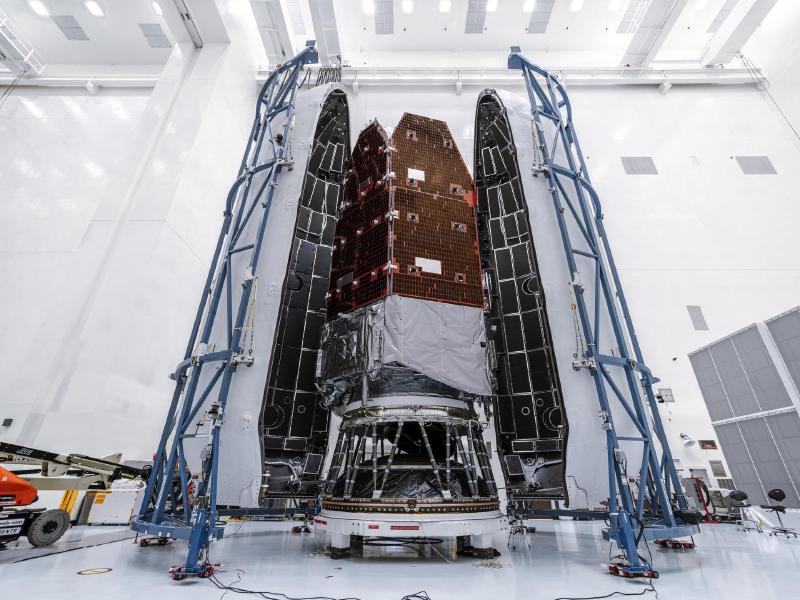
Based on ephemeris data downloaded from NASA Horizons, observers in Malaysia may have an opportunity to view the pass of the Falcon Heavy upper-stage rocket used during the launch of the Nancy Grace Roman Space Telescope from Kennedy Space Center, Florida, United States of America.
Observation reports#
Australia#
And a short time-lapse of today’s recordings of the Nancy Grace Roman Space Telescope and the Falcon upper stage (leading). Recorded on 2026-08-30 between 12:38:18 and 13:21:23 UTC. #NASARoman pic.twitter.com/taK0jNGAqZ
— s2a systems (@s2a_systems) August 30, 2026
Launch countdown#
At the time of writing, the launch is scheduled for Sunday, August 30, 2026, 7:26:04 PM Malaysia time1.
Confidence Level#
★★☆☆☆
Factors:
- The Falcon Heavy upper-stage engine burn ends before it becomes visible from Malaysia: second-stage engine start (2nd stage engine starts (SES-2)) occurs 24 minutes 33 seconds after launch (~7:50 PM) and second-stage engine cutoff (2nd stage engine cutoff (SECO-2)) occurs 26 minutes 32 seconds after launch (~7:52 PM).
- Therefore, there might only a chance to observe the passivation (propellant venting) operation of the Falcon Heavy upper stage after the mission concludes. The exact time for this operation is unknown, but it typically occurs shortly after payload separation. The Nancy Grace Roman Space Telescope is scheduled to separate from the rocket 31 minutes 31 seconds after launch (~7:57 PM).
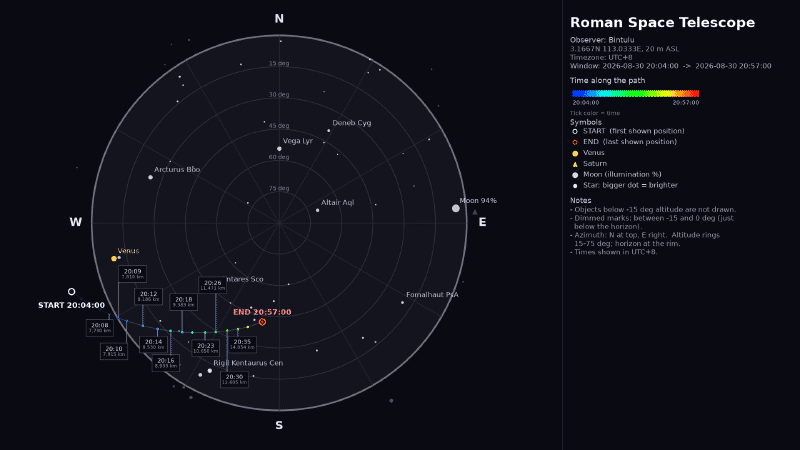
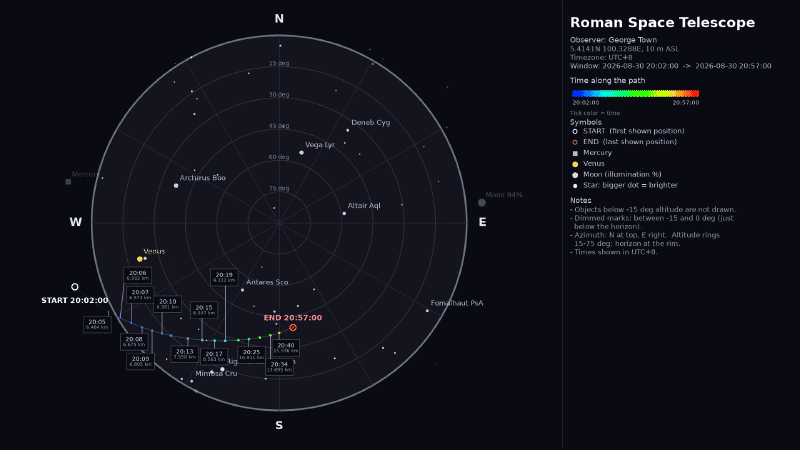
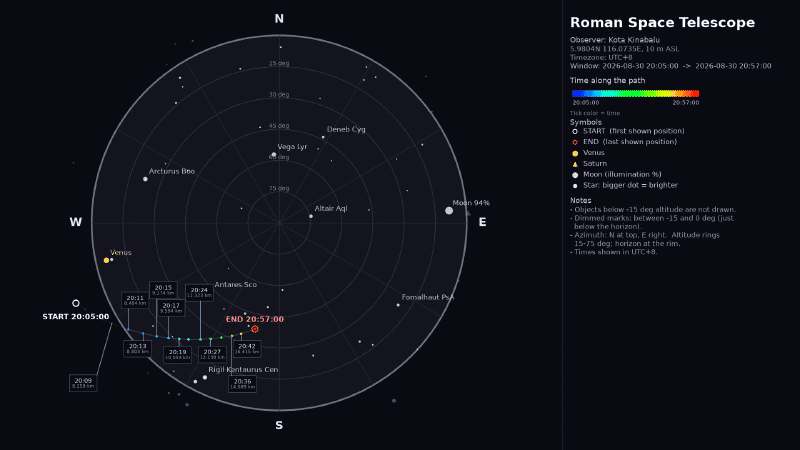
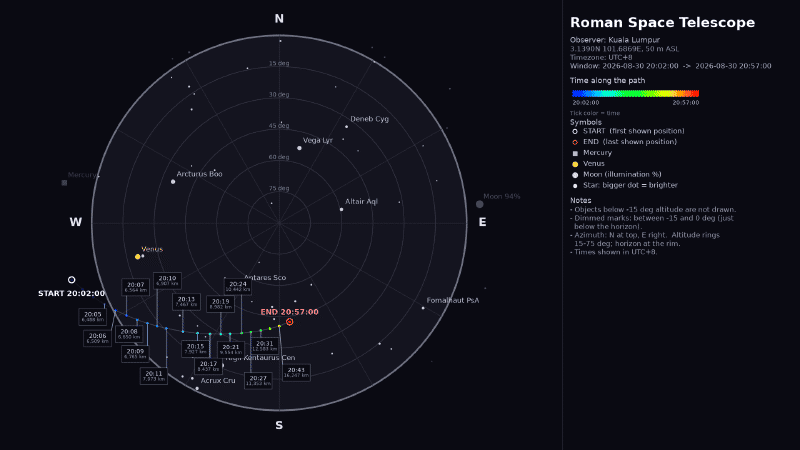
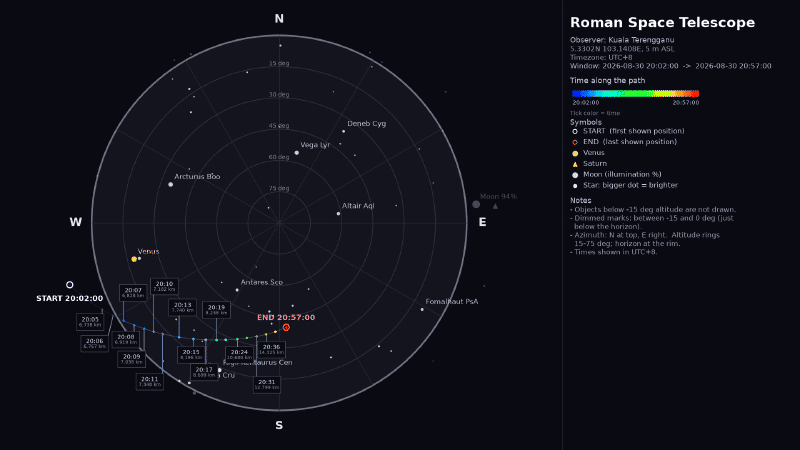
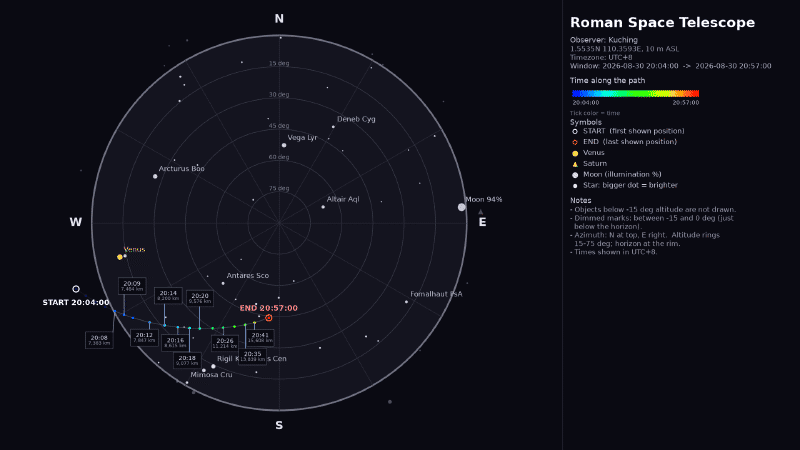
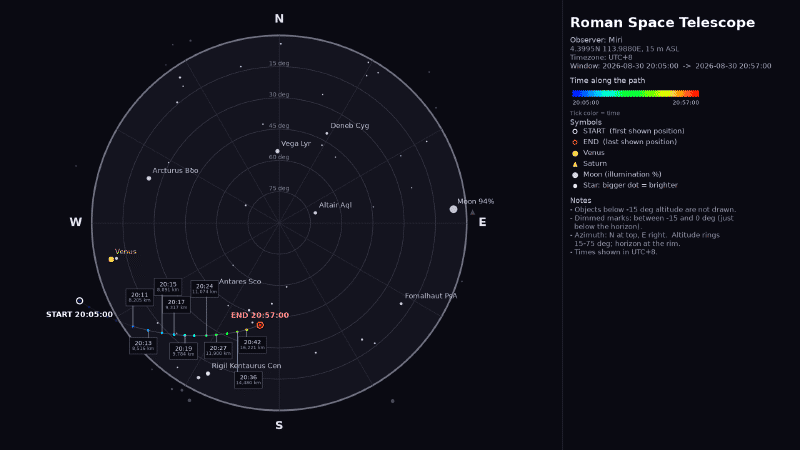
- When the trajectory becomes visible from Malaysia, the distance of the Nancy Grace Roman Space Telescope from observers in Malaysia will be over 6,000 km. As a result, this pass may be difficult to see with the naked eye, though it might be captured using long-exposure photography.
Trajectory#
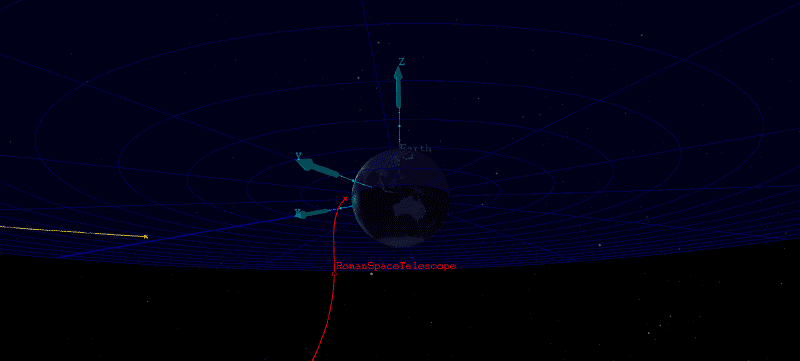
Below is the trajectory of the Nancy Grace Roman Space Telescope generated using ephemeris data downloaded from NASA Horizons.
After payload deploy, the Falcon Heavy upper-stage rocket used for this launch will remain relatively close to the Nancy Grace Roman Space Telescope, so this trajectory can also be used to track the position of the upper stage during post-mission passivation.
The generated trajectories are based on the launch time at 7:26 PM Malaysia time.
Sky maps#
Below are sky maps for several major locations in Malaysia.



Trajectory animation#
GMAT#
Stellarium#
Bintulu, Sarawak#
Kuala Terengganu, Terengganu#
Sandakan, Sabah#
Watch live launch coverage#
Official#
NASA#
SpaceX#
Unofficial#
NASASpaceflight#
Spaceflight Now#
These are manual predictions based on public data and may contain inaccuracies.
To view the rocket pass, the following conditions must be met:
Dark and Clear Skies: It must be dark with clear skies at the observer’s location.
Sunlit Rocket: The rocket must be high enough to catch sunlight.
Active Firing or Fuel Dump: While passing overhead, the rocket must be doing either of the following:
Engine Burn: The rocket engine is actively firing.
Passivation / Fuel Dump: The rocket stage is dumping leftover fuel at the end of its mission (this is generally fainter and harder to spot than an engine burn).
Cover image: NASA/Sydney Rohde (Rocz)
Launch window. (Spaceflight Now) ↩︎